Hotels Command a 5% Reliability Premium
Airbnb Avg
Hotel Avg
Strategic Decision: Hotels command a +$6 'Reliability Premium'. Recommendation: Hold rates steady and leverage service consistency over price wars.
Scope: NYC Market Analysis (2024) • Source: Tableau Analytics (116k Data Points)
Legacy Blindspot: Stakeholders lacked unified metrics to benchmark performance across distinct asset classes (Fixed Hotel Inventory vs. Variable Airbnb Listings). This created a "yield gap" during high-demand periods.
Forensic Engineering: Engineered a proprietary Tableau dashboard to filter 116,000+ data points. Isolated "Guest Type" behaviors to correct the "Revenue vs. Rate" fallacy and map true demand drivers.
Strategic Nuance:
Validated that Hotels command a "Reliability Premium" ($129 ADR) compared to Airbnb's
"Leisure Flexibility" ($123).
Crucial
Insight: While distinct, competitive overlap spikes during Peak Seasons,
requiring distinct yield strategies rather than a blanket price war.
Stakeholders reacted to Airbnb's growth with reactive price cuts, lacking visibility into whether they were losing customers to Airbnb or simply facing different demand patterns. This "Data Blindspot" threatened brand equity.
The mission was to validate: Is Airbnb a direct "Substitute" (requiring aggressive price wars) or a distinct "Market Segment" (requiring differentiation)?
Built a proprietary Tableau Dashboard (analyzing 116k data points) to isolate "Guest Type" behaviors. Correlated "Complaint Spikes" with "Occupancy Rates" to map operational breaking points.
Disproved the "Total Substitution" theory. Validated that Hotels command a "Reliability Premium," with direct competitive overlap occurring only during Peak Seasons (not year-round).
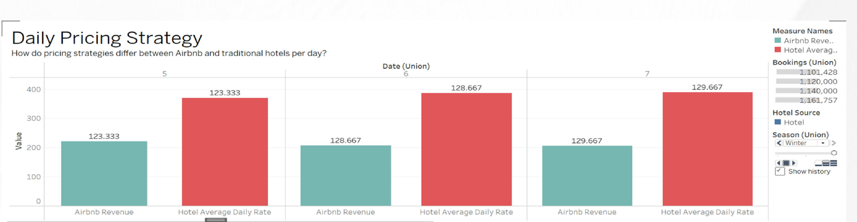
Forensic Analysis of ADR Stability vs. Algorithmic Volatility (Data Source: Tableau, 116k Points)
Hotels (The Anchor): Maintain rigid pricing (~$129) to guarantee predictability for business travelers.
Airbnb (Yield Volatility Risk): Uses algorithmic pricing (~$123) to undercut, appealing only to leisure tourists.
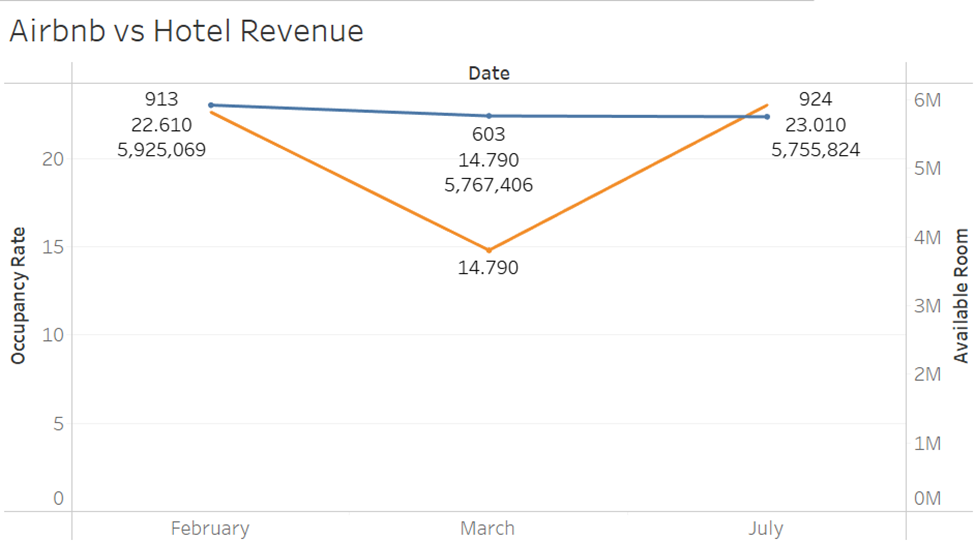
Trend Analysis: Peak Season Overlap vs. Complaint Volume (Source: Tableau)
Competitive overlap occurs strictly during Summer Peak (Jun-Aug). Airbnb inventory absorbs overflow demand when Hotel occupancy hits >90%.
High Airbnb occupancy correlates with a 30% spike in Guest Complaints (Noise/Cleanliness), whereas Hotels maintain service consistency.
✓ RECOMMENDATION: Leverage Airbnb as a "Peak Season Overflow" channel. Allow competitive overlap strictly during high-demand periods (>90% occupancy) to protect rate integrity.
Data Source: Tableau Analysis of 116k bookings (NYC Market, 2024). Complaint correlations based on sentiment analysis derived specifically during >90% occupancy periods.
Strategic Mandate & Forward-Looking Protocol (Next Steps)